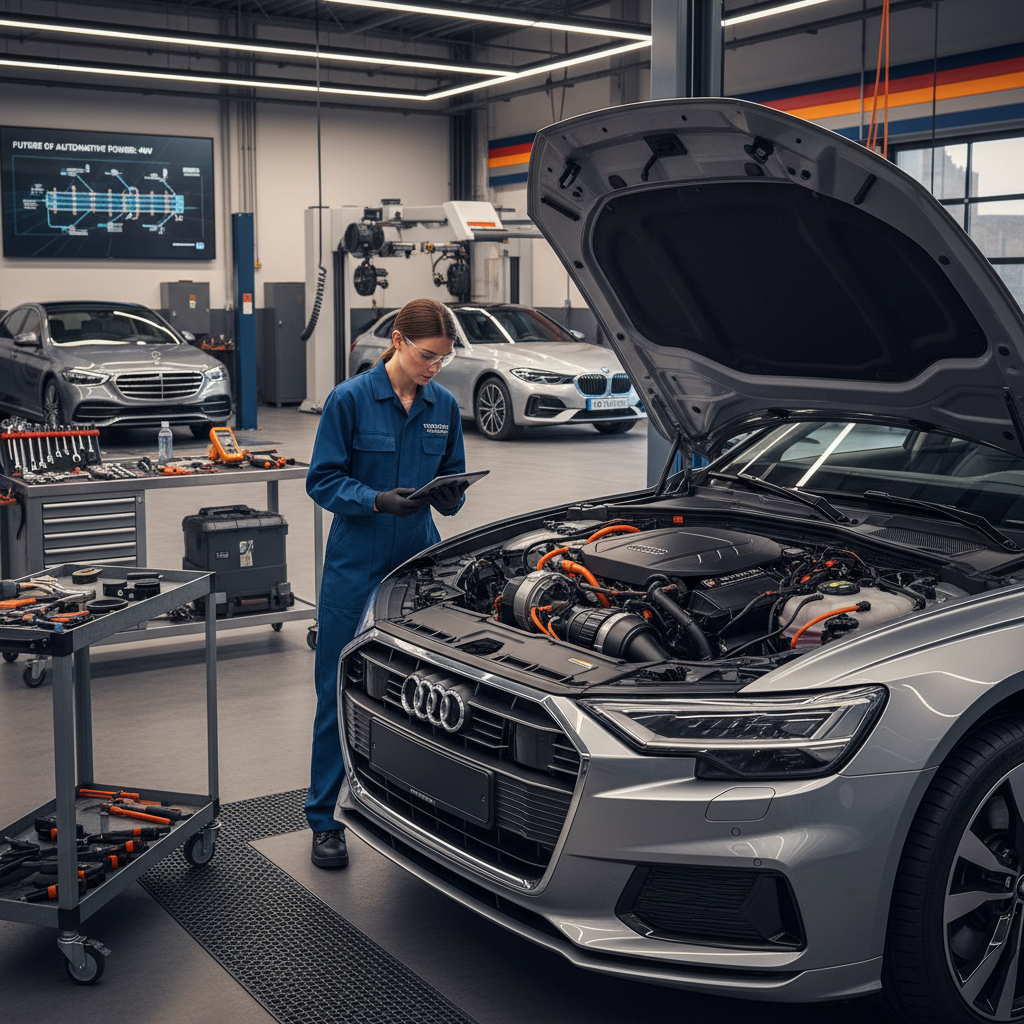
Summary
48-volt (48V) electrical systems are reshaping the automotive industry, bridging traditional 12-volt systems and the high-voltage architectures of fully electric vehicles. This technology facilitates the adoption of mild hybrid electric vehicles (MHEVs), enhancing fuel efficiency, lowering emissions, and improving vehicle performance through features like electric turbochargers and start-stop systems. Initially advanced by major German manufacturers in 2011, 48V systems deliver higher power—up to 20 kW—while simplifying safety requirements, thus improving key vehicle systems. Although challenges like higher initial costs and the complexity of integrating legacy systems persist, leading brands are increasingly adopting 48V technology. The market for 48V systems is set for rapid growth, driven by regulatory demands and consumer preferences for efficient mobility.
History and Development
The push for 48-volt systems began in 2011, driven by major German automakers aiming to enhance efficiency and enable mild hybrid technologies without incurring the complexities of high-voltage systems. This architecture allows for minor yet impactful upgrades like regenerative braking and electric generators. Initial adoption faced challenges including substantial investments for redesigning vehicles and the lack of global standards tailored for 48V systems. The introduction of ISO 21780-4 has enabled a unified framework that supports broader implementation. Presently, the market is experiencing rapid growth, with projections suggesting an increase from approximately USD 23 billion in 2024 to over USD 60 billion by 2033, particularly in Europe, which represents around 40% of market revenue.
Technical Overview
The transition to a 48-volt architecture reflects the increasing power demands of modern vehicles. These systems employ a distributed power-delivery architecture, deriving 48V from the vehicle’s high-voltage battery and stepping it down to 12V when necessary. This design reduces current flow, allowing the use of lighter wiring while maintaining reliability. The dual-voltage setup enables seamless integration of 48V and traditional 12V systems, enhancing efficiency and performance without discarding legacy electronics. This enables the electrification of features like start-stop systems and electric turbochargers, which assist traditional combustion engines.
Challenges and Standards
Despite their benefits, 48V systems pose new challenges including wiring design and thermal management due to higher currents and voltages. Advanced shielding and EMI mitigation are crucial due to increased emissions at these levels. The absence of standardized components specifically for 48V systems complicates their development, with manufacturers often relying on practices from other industries. Implementing unified standards would enhance reliability and confidence in these systems while reducing costs.
Advantages
48V systems offer significant advantages over traditional 12-volt architectures by providing higher power outputs, which enable the electrification of high-demand vehicle components. This transition improves vehicle efficiency, fuel economy, and environmental impact significantly—studies suggest a reduction of 15% to 25% in emissions with widespread adoption. Additionally, the architecture’s lower cost and simplicity make it a viable option for automakers aiming to modernize while maintaining lighter designs and cost efficiencies. Enhanced thermal management systems further benefit from 48V architectures, improving performance and driving range, and translating into tangible savings for consumers over the vehicle’s lifecycle.
Applications
Common applications for 48V systems include mild-hybrid electric vehicles (MHEVs), which leverage the technology to deliver substantial fuel economy improvements. Automakers employ 48V architectures to support advanced components like electric turbochargers and active suspension systems. Popular models featuring 48V technology include the Renault Scenic dCi Hybrid Assist and luxury vehicles from Audi and Mercedes-Benz. Beyond MHEVs, applications extend to high-performance vehicles and even some pickup trucks, showcasing 48V systems as crucial for enhancing traditional combustion engines without the expense of full electrification.
Challenges and Limitations
While 48V systems present numerous advantages, they also face challenges that hinder widespread adoption. Transitioning requires significant investments in redesigning vehicle architectures and developing components that meet new safety standards. The high initial cost of 48V-specific components compared to 12V parts can be a barrier, alongside the increased system complexity from coexisting 12V and 48V systems. Successfully managing EMI and thermal issues also complicates the implementation of these systems, underscoring the need for careful engineering and design solutions.
Comparison with Other Electrification Technologies
48V systems represent a critical intermediary in vehicle electrification, offering substantial advancements over 12-volt architectures while avoiding the complexities of high-voltage systems. They facilitate the integration of modern technologies in vehicles demanding increased power without the high safety requirements of systems above 60 volts. While fully electric vehicles utilize higher voltages for efficiency, the 48V system provides a practical solution for improving internal combustion engines and mild hybrids, aiming for better fuel economy and reduced emissions.
Future Prospects
Looking ahead, the future of 48V systems is bright, driven by technological advancements and regulatory pressures. Expected developments include smart junction boxes optimizing system architecture for enhanced performance. The market for 48V systems is projected to grow significantly, reaching approximately USD 171.45 billion by 2033, with Europe leading this expansion. Innovations in system efficiency and a focus on sustainability are propelling the adoption of 48V platforms, paving the way for their standardization in advanced vehicle technologies and promising substantial contributions to future automotive performance and environmental initiatives.
The content is provided by Jordan Fields, Brick By Brick News